

Can the follicles you still have be encouraged to work harder, or do you need hair moved from somewhere else? That is the repair versus replace decision. Non-surgical treatment sits on the repair side, surgery sits on the replace side, and knowing which fits you saves money and frustration. This article explains how the non-surgical option offered at Clinicare Fitzroy works, what it asks of you, and where its limits are.
Can non-surgical treatment actually regrow hair?
It can help some people, but no one can promise it, and results depend on why the hair is thinning in the first place. Non-surgical treatment works with follicles that are still present, which is why it is described as repair rather than replace.
The treatment Clinicare offers for hair loss is Platelet Rich Plasma therapy, usually shortened to PRP. The clinic describes it as a non-invasive cosmetic treatment and “the latest innovation for hair restoration”. The aim is to stimulate hair growth in the scalp, not to build a new hairline.
That distinction matters. A follicle that has stopped producing hair altogether is a different problem from one that is shrinking or sluggish. Anyone telling you a clinic treatment will certainly bring back a full head of hair is overpromising. A good consultation should talk about likelihood and limits, not guarantees, and this article makes no promise of a result either.
Repair or replace: what each approach is actually doing
Repair means working on the hair and follicles you already have, while replace means relocating hair to where it has gone missing.
Non-surgical treatment is on the repair side. There is no incision, no graft and no recovery from a surgical wound. The treatment is a series of sessions that aim to stimulate the scalp, and the effort is spread over months.
Surgery, generally speaking, is a replace approach. A transplant typically takes hair from a donor area and places it where thinning has occurred. It is usually a single, more involved procedure, and it needs enough suitable donor hair to work with. This article describes surgery only as general background.
Neither is automatically better. The useful question is which one matches how much hair you still have, how fast you are losing it, and how much time, cost and downtime you are prepared to accept.
What PRP for hair loss involves at Clinicare Fitzroy
The process starts with your own blood and ends with an injection into the scalp, all at your appointment.
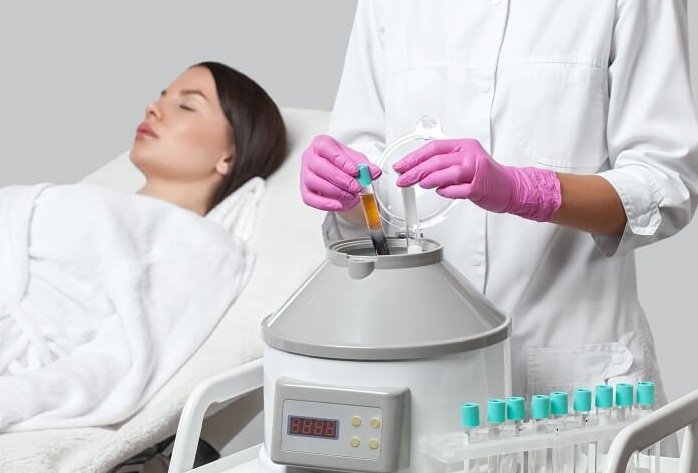
Blood is taken and placed in a centrifuge, a spinning machine that separates its elements. The resulting platelet rich plasma is prepared and re-injected into the scalp to stimulate hair growth. Local anaesthetic is used to numb the injection site.
Clinicare notes that you are capable of self-care after a session, but that some patients prefer to have a friend or family member with them for the trip home. If you would rather not travel alone after a procedure involving needles, plan for that in advance. Tram 86, Stop 17 is the stop for the Smith Street clinic, and the entry is on Webb Street.
PRP is also used in another treatment at the clinic, and you can read about it on the Vampire Facial page.
What the commitment looks like in time and money
This is not a one visit fix. Clinicare states that at least six treatments, spaced one month apart, are required to treat hair loss, and that each treatment is $550.
That means the course stretches across at least six months, and the per session price is the figure to hold on to when you plan. Your own plan is something to confirm directly with the doctor.
It helps to think about this the way you would a gym program. A single session rarely tells you much, and hair also grows slowly, so you are judging progress over months. If you are the kind of person who will skip appointments partway through, that is worth admitting before you start, because a half finished course is a likely way to waste the money.
Clinicare is a private billing practice, so consultations carry an out of pocket cost. Details are on the fees page. The cosmetic consultation for hair loss is the exception, as it is free.
Weighing up the trade offs against surgery
Non-surgical treatment trades certainty and speed for lower invasiveness, and that is the real comparison to make.
- Downtime and risk: PRP involves needles and a local anaesthetic but no surgical wound. Surgery, as a general rule, involves a longer recovery and the usual risks of any procedure.
- Time to see a difference: PRP asks for at least six monthly sessions. A surgical result is also gradual, but it is delivered in one procedure rather than built up over a course.
- What it can address: A repair approach needs follicles that are still capable of producing hair. Where an area is completely bare, replacement is more likely to be the conversation.
- Reversibility: You can stop a non-surgical course. A transplant is permanent by nature.
For someone with early or diffuse thinning who is not ready for an operation, starting with the less invasive path is a reasonable first step. For someone with extensive, long established loss, an honest consultation may tell you the repair route has limited room to move.
Why the cause of your hair loss comes first
Hair loss is a symptom with many possible causes, and treating the scalp will not help much if the driver is elsewhere.
In general, thinning can be linked to things like hormonal changes, thyroid problems, low iron, certain medications, significant stress or illness, and inherited patterns. Which one applies to you is a question for a doctor. Sudden or patchy hair loss, an itchy or painful scalp, or hair loss alongside other symptoms is worth raising with a doctor before you commit to any cosmetic treatment.
Clinicare is a medical centre with a team of GPs and registered nurses, so you can ask general health questions alongside the cosmetic one. If you have a health condition, take regular medication, or are pregnant or breastfeeding, check with your own doctor before starting PRP. This article is general information and does not replace medical advice, and PRP is not presented as a treatment or cure for any medical condition.
Starting the conversation in Fitzroy
The first step is a free cosmetic consultation with Dr Ovida Vipulaguna, a General Practitioner and Cosmetic Physician at Clinicare Fitzroy, 165 Smith Street.
That consult is where you find out whether you are a realistic candidate for the repair approach, rather than guessing from a web page. It is worth going in with a few questions:
- Based on my pattern of hair loss, is repair realistic or should I be thinking about replacement?
- Is there anything I should have checked first with a GP?
- What does a full course look like for me, and what will it cost in total?
- How will we judge whether it is working, and when would we reassess?
You can read about the service on the hair loss treatment page, then phone (03) 9417 3377 or use the contact page to arrange a time. The Smith Street clinic is open Monday to Friday 8.30am to 6pm and Saturday 9am to 1pm, and is closed on Sunday.
Frequently asked questions
Is the hair loss consultation free?
Dr Vipulaguna offers a free initial cosmetic consultation, and the clinic invites you to book a free cosmetic consult to discuss PRP for hair loss. Other consultations at Clinicare are privately billed with an out of pocket cost.
Does the injection hurt?
Local anaesthetic is used to numb the injection site before the PRP is re-injected. How a procedure feels varies from person to person, so the consultation is the place to ask the doctor what you can expect.
Which Clinicare location offers the hair loss consult?
The free cosmetic consult for PRP hair loss treatment is with Dr Vipulaguna at Clinicare Fitzroy, 165 Smith Street, with entry on Webb Street. Call (03) 9417 3377 to arrange a time.
Related pages
This article draws on the following pages.